
The resistance of a conductor depends on four main factors: (1) the material of the conductor, (2) its length, (3) its cross-sectional area, and (4) its temperature. These factors determine how easily current can flow through the conductor and are critical when designing electrical systems or choosing wire types.
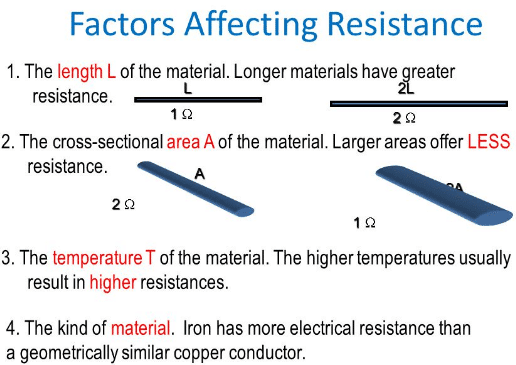
on what factors resistance of a conductor depends
In this article, we explain how each of these factors influences resistance and why they matter in real-world applications.
🔍 What is Electrical Resistance?
Resistance is the property of a material that opposes the flow of electric current. It is measured in ohms (Ω) and symbolized by the letter R. A conductor with high resistance will reduce current flow, while a low-resistance conductor allows more current to pass through easily.
📐 Resistance Formula
The basic formula for resistance is:
R=ρ⋅LAR = \rho \cdot \frac{L}{A}
Where:
-
RR = resistance (ohms, Ω)
-
ρ\rho = resistivity of the material (ohm-meter, Ω·m)
-
LL = length of the conductor (meters)
-
AA = cross-sectional area of the conductor (square meters)
⚙️ Key Factors That Affect the Resistance of a Conductor
Here are the four main factors on which the resistance of a conductor depends:
1. Material (Resistivity, ρ)
Different materials have different inherent abilities to conduct electricity.
-
Copper and aluminum have low resistivity, meaning they offer low resistance.
-
Nichrome or iron have higher resistivity and offer more resistance.
🔎 Search tip: People often look for “which material has the least resistance” or “best conductor material”.
2. Length of the Conductor (L)
The longer the wire, the greater the resistance.
-
Resistance increases linearly with length.
-
A wire twice as long will have twice the resistance.
Example: A 10-meter copper wire has more resistance than a 5-meter one of the same thickness.
3. Cross-sectional Area (A)
The thicker the wire, the lower the resistance.
-
Resistance is inversely proportional to area.
-
Doubling the diameter reduces resistance significantly.
This is why high-power appliances use thicker cables.
4. Temperature
As the temperature of a metal conductor increases, its resistance usually increases.
-
In metals: atoms vibrate more at higher temperatures, impeding electron flow.
-
In some materials like semiconductors, resistance decreases with temperature.
That’s why overheating wires can become dangerous—they offer more resistance, generating more heat.
📊 Summary Table: Resistance Dependency
| Factor | Relationship to Resistance |
|---|---|
| Material | Depends on resistivity (ρ) |
| Length | Directly proportional |
| Cross-sectional Area | Inversely proportional |
| Temperature | Usually increases resistance in metals |
🧠 Real-World Examples
-
A long extension cord gets warm? That's due to increased resistance from longer wire length.
-
Power transmission lines use aluminum because it's light and has low resistance.
-
Microelectronics use short, thin, precise conductors to minimize resistance for performance.
📚 Related Questions Users Also Ask
-
Why does resistance increase with length?
-
Does wire gauge affect resistance?
-
How does temperature affect resistance in copper?
-
Which conductor has the highest resistance?
These are great follow-up searches that show a deeper user learning journey.
📞 Need Help Selecting Low-Resistance Wire?
At TOT Wire & Cable, we provide copper and aluminum conductors designed for low resistance, efficient transmission, and customized sizing to fit your voltage and application needs.
👉 Contact us today to request a quote or ask about wire resistance and conductivity.


