Introduction
Electricity travels a long journey from power plants to your home or business. Along the way, it passes through different types of power lines, each serving a specific purpose in the transmission and distribution network. The three most common types are overhead lines, underground lines, and subtransmission lines.
In this article, we’ll explain:
What each type of transmission line is
How they differ in design, voltage, and cost
Their advantages and disadvantages
When each is used in modern power grids
3 types of transmission lines
1. Understanding the Power Delivery System
Before diving into the types of transmission lines, let’s look at how electricity flows:
Generation – Power plants generate electricity, often at 11–25 kV.
Step-Up Transmission – Transformers boost the voltage (e.g., 115–765 kV) for efficient long-distance transport.
Subtransmission – Intermediate-voltage lines (typically 23–69 kV, sometimes 115 kV) bring power closer to local substations.
Distribution – Lower-voltage lines (e.g., 4–25 kV) deliver power to neighborhoods.
Service Drop – The final connection to homes or businesses (120/240V in the U.S.).
2. Overhead Transmission Lines
Definition
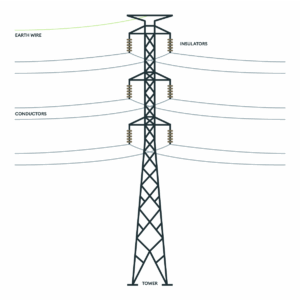
Overhead transmission lines are the most common type of high-voltage power line. They consist of bare conductors mounted on towers or poles, supported by insulators.
Key Features
Voltage Range: 115 kV – 765 kV (sometimes even higher for UHV systems).
Materials: Aluminum Conductor Steel Reinforced (ACSR), Aluminum Alloy Conductor (AAAC), or copper.
Structures: Lattice towers, wooden poles, or steel poles.
Advantages
Cost-effective: Cheaper to install compared to underground cables.
Easier Maintenance: Faults are visible and easier to repair.
Higher Current Capacity: Less heat buildup due to open-air cooling.
Disadvantages
Weather Exposure: Susceptible to storms, lightning, and ice.
Visual Impact: Affects landscapes and city views.
Safety Risks: Falling lines can cause hazards.
3. Underground Transmission Cables
Definition
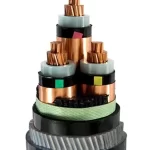
Underground cables carry high-voltage electricity below ground, using heavily insulated conductors such as XLPE (cross-linked polyethylene) or HPFF (High-Pressure Fluid-Filled) cables.
Key Features
Voltage Range: Up to 400 kV (special designs can exceed this).
Installation: Buried directly or inside ducts/conduits.
Protection: Layers of insulation, metallic shielding, and sometimes steel armoring.
Advantages
Aesthetics: Invisible and does not affect the skyline.
Less Weather Impact: Protected from storms and lightning.
Security: Reduced risk of accidental contact.
Disadvantages
High Cost: 5–10 times more expensive than overhead lines.
Complex Repairs: Fault detection and repair can be slow and costly.
Heat Dissipation: Requires special design for thermal management.
4. Subtransmission Lines
What Is Subtransmission?
Subtransmission lines bridge the gap between high-voltage transmission and local distribution networks. They carry power from bulk substations to smaller local substations.
Voltage Range: Typically 23–69 kV (some up to 115 kV).
Configuration: Can be overhead or underground.
Role: Reduces transmission voltage to a level that distribution transformers can manage.
Why It Matters
Subtransmission ensures power reliability by feeding local grids and allowing utilities to reroute electricity during outages or maintenance.
5. Overhead vs Underground vs Subtransmission: Key Differences
| Feature | Overhead Lines | Underground Cables | Subtransmission Lines |
|---|---|---|---|
| Voltage | 115–765 kV | Up to 400 kV | 23–69 kV (some 115 kV) |
| Cost | Low | High | Medium |
| Maintenance | Easy & quick | Difficult & costly | Moderate |
| Visual Impact | High | None | Depends on type |
| Common Use | Long-distance transmission | Urban areas, critical crossings | Intermediate stage |
6. Applications and Cable Types
Overhead Lines: Use ACSR or AAAC conductors.
Underground Lines: Often rely on XLPE cables or HPFF cables.
Subtransmission: Can use covered conductors, compact overhead designs, or medium-voltage XLPE cables.
If you’re sourcing underground cables, XLPE insulated power cables with steel wire armor are a reliable choice. For overhead applications, ACSR conductors remain industry-standard.
7. Choosing the Right Type
Utilities and engineers consider:
Cost vs. aesthetics: Underground cables are ideal for urban centers but cost more.
Reliability: Overhead lines are easier to repair, while underground lines are protected from weather.
Environmental constraints: Protected areas or river crossings often require underground solutions.
Voltage and distance: Long-distance, high-voltage power favors overhead.
8. FAQs
1. Is subtransmission the same as distribution?
No. Subtransmission operates at higher voltages (23–69 kV), while distribution networks typically run below 25 kV.
2. Why don’t we bury all power lines?
The cost and complexity of underground cables make it impractical for all regions.
3. Can subtransmission be underground?
Yes. Urban utilities sometimes install subtransmission cables underground to save space and avoid visual clutter.
Conclusion
Understanding overhead, underground, and subtransmission lines is key to appreciating how electricity flows to your home. Overhead lines are cost-effective and widely used, underground lines are aesthetically pleasing but expensive, and subtransmission bridges the high-voltage and low-voltage worlds.
If you need high-quality overhead conductors or underground XLPE cables, choosing a reliable supplier ensures performance and safety. [Contact TOT Wire & Cable] for expert advice on transmission and distribution solutions.