What Are the Different Types of Romex Wiring?
Romex wiring comes in multiple types based on wire gauge (thickness), number of conductors, and environmental rating. The most common types include 14/2, 12/2, 10/2, 14/3, 12/3, and 10/3 cables, each designed for specific electrical loads and applications.
Understanding which type of Romex to use is critical for safe, code-compliant electrical installations. Using the wrong type can lead to overheating, circuit breaker trips, or even electrical fires.
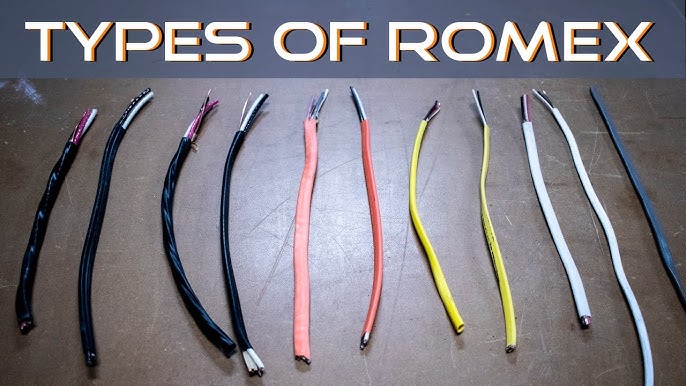
types of romex wiring
Understanding Romex Wire Naming
Before diving into specific types, it's important to understand how Romex cables are named.
The Number System Explained
Romex cables use a two-number designation: AWG/Conductor Count
Example: 12/2 Romex
- 12 = Wire gauge (12 AWG - American Wire Gauge)
- 2 = Number of current-carrying conductors
- Plus one bare ground wire (not counted in the designation)
What's actually inside 12/2 Romex:
- 1 black wire (hot)
- 1 white wire (neutral)
- 1 bare copper wire (ground)
- Total: 3 wires, but called '12/2'
What's inside 12/3 Romex:
- 1 black wire (hot)
- 1 red wire (hot)
- 1 white wire (neutral)
- 1 bare copper wire (ground)
- Total: 4 wires, but called '12/3'
Wire Gauge Basics
In the American Wire Gauge (AWG) system:
- Lower number = Thicker wire = Higher capacity
- 14 AWG is thinner than 12 AWG
- 12 AWG is thinner than 10 AWG
Thicker wires carry more electrical current safely without overheating.
Types of Romex by Wire Gauge
1. 14 AWG Romex (White Jacket)
Ampacity: 15 amps maximum Breaker Size: 15 amp Jacket Color: White (traditional), Blue for 14/3 (2024+)
Common Configurations:
- 14/2 Romex - Standard lighting circuits
- 14/3 Romex - Three-way switch circuits
Best Uses:
- ✅ Lighting fixtures and switches
- ✅ Bedroom and living room outlets (light loads)
- ✅ Ceiling fans
- ✅ Smoke detectors and security systems
- ✅ Low-power electronics
Limitations:
- ❌ Cannot handle high-power appliances
- ❌ Not suitable for kitchen counter outlets (requires 20A)
- ❌ Should not be used for bathroom outlets
- ❌ Not for air conditioners or heaters
Cost:
Most affordable Romex option, typically $0.40-0.60 per foot for 14/2.
Code Note: While 14 AWG is code-compliant for 15-amp circuits, many electricians prefer 12 AWG throughout the house for future flexibility and reduced voltage drop.
2. 12 AWG Romex (Yellow Jacket)
Ampacity: 20 amps maximum Breaker Size: 20 amp Jacket Color: Yellow (traditional), Purple for 12/3 (2024+)
Common Configurations:
- 12/2 Romex - Standard household outlets
- 12/3 Romex - Kitchen circuits, three-way switches
Best Uses:
- ✅ Kitchen counter outlets (code requirement)
- ✅ Bathroom outlets
- ✅ Garage outlets
- ✅ Washing machines
- ✅ Dishwashers
- ✅ Garbage disposals
- ✅ Microwave ovens (built-in)
- ✅ General purpose outlets throughout home
Advantages Over 14 AWG:
- Can handle more simultaneous loads
- Less voltage drop over distance
- Better future-proofing
- Required by code in many locations
Cost:
Mid-range pricing, typically $0.60-0.90 per foot for 12/2.
Professional Tip: Many electricians use 12/2 for all general circuits, even where 14/2 would be code-compliant. The small cost difference provides significant benefits.
3. 10 AWG Romex (Orange Jacket)
Ampacity: 30 amps maximum Breaker Size: 30 amp Jacket Color: Orange (traditional), Pink for 10/3 (2024+)
Common Configurations:
- 10/2 Romex - Water heaters, window AC units
- 10/3 Romex - Electric dryers, ovens
Best Uses:
- ✅ Electric water heaters
- ✅ Central air conditioner condenser units
- ✅ Electric dryers
- ✅ Electric ranges (smaller models)
- ✅ Large window air conditioners
- ✅ Pool pumps
- ✅ Workshop equipment (240V)
When You Need 10/3 vs 10/2:
- 10/2: 240V loads without neutral (water heater, AC)
- 10/3: 240V loads requiring neutral (dryer, range)
Cost:
Significantly more expensive, typically $1.20-1.80 per foot for 10/2.
4. 8 AWG Romex (Gray Jacket)
Ampacity: 40 amps maximum Breaker Size: 40 amp (can also use 30A breaker) Jacket Color: Gray
Common Configurations:
- 8/2 Romex - Sub-panels, large AC units
- 8/3 Romex - Electric ranges, cooktops
Best Uses:
- ✅ Electric ranges and cooktops
- ✅ Sub-panel feeders (short runs)
- ✅ Large central air conditioners
- ✅ Heat pumps
- ✅ Hot tubs (small models)
Limitations:
- Not suitable for main service entrance
- Limited to 40 amp circuits
- Check manufacturer specs for appliances
Cost:
Expensive, typically $2.00-3.00 per foot for 8/3.
Note: 8 AWG Romex is relatively uncommon. For 40-50 amp loads, many electricians prefer individual THHN wires in conduit or use larger gauge wire.
5. 6 AWG Romex (Gray Jacket)
Ampacity: 55 amps maximum (in residential typically used for 50A circuits) Breaker Size: 50 amp Jacket Color: Gray
Common Configurations:
- 6/2 Romex - Rare
- 6/3 Romex - Large electric ranges, sub-panels
Best Uses:
- ✅ Large electric ranges
- ✅ Sub-panel feeders (moderate distance)
- ✅ EV charging stations (Level 2, 40A)
- ✅ Large heat pumps
Important Considerations:
- Very thick and stiff cable
- Difficult to work with
- May require larger junction boxes
- Check box fill calculations carefully
Cost:
Very expensive, typically $3.50-5.00 per foot for 6/3.
Types of Romex by Conductor Count
Two-Conductor Romex (/2)
Contains:
- 1 hot wire (black)
- 1 neutral wire (white)
- 1 ground wire (bare copper)
Voltage: 120V single-phase
Best For:
- Standard 120V circuits
- Simple on/off switches
- Lighting fixtures
- Most household outlets
- Appliances not requiring 240V
Visual Identification:
Look for the '/2' designation printed on the cable jacket.
Three-Conductor Romex (/3)
Contains:
- 1 hot wire (black)
- 1 hot wire (red)
- 1 neutral wire (white)
- 1 ground wire (bare copper)
Voltage: 120V or 240V (depending on application)
Best For:
- Three-way and four-way switch circuits
- Split-receptacle circuits
- 240V appliances requiring neutral (dryers, ranges)
- Multi-wire branch circuits
- Circuits feeding multiple locations
Common Applications:
Three-Way Switches:
Light controlled from two locations
- Black: Traveler wire
- Red: Traveler wire
- White: Neutral (or switched hot, marked)
240V Appliance (with neutral):
Electric dryer connection
- Black: 120V hot
- Red: 120V hot (creates 240V between black and red)
- White: Neutral return
- Combined: Provides both 240V and 120V
Split Receptacle:
Duplex outlet with separate circuits
- Black: Feeds top outlet
- Red: Feeds bottom outlet
- Each can be on different circuit/switch
Types of Romex by Environmental Rating
NM-B Cable (Standard Romex)
Full Name: Non-Metallic Building Cable Temperature Rating: 90°C (194°F) conductor temp, but ampacity based on 60°C (140°F)
Approved Locations:
- ✅ Inside walls
- ✅ Inside ceilings
- ✅ Inside floors
- ✅ Dry locations only
- ✅ Protected from physical damage
Prohibited Locations:
- ❌ Outdoors (exposed)
- ❌ Wet or damp locations
- ❌ Embedded in concrete
- ❌ Underground (direct burial)
- ❌ Exposed in garages below 8 feet
- ❌ Commercial buildings (most types)
Jacket Material: PVC (Polyvinyl Chloride)
Cost: Standard baseline pricing
UF-B Cable (Underground Feeder)
Full Name: Underground Feeder Cable Temperature Rating: 60°C to 75°C (varies by manufacturer)
Key Differences from NM-B:
- Solid molded jacket (not just wrapped)
- Moisture resistant
- Sunlight resistant
- Can be buried directly
- More flexible than NM-B
- Gray jacket color
Approved Locations:
- ✅ Direct burial underground
- ✅ Outdoors (exposed or buried)
- ✅ Damp locations
- ✅ Inside conduit (underground runs)
- ✅ Wet locations
- ✅ All locations where NM-B is allowed
Common Uses:
- Detached garage/shed wiring
- Outdoor lighting circuits
- Well pump connections
- Landscape lighting feeders
- Pool/hot tub circuits (outside house)
Burial Depth Requirements:
- 24 inches minimum (residential 120V)
- 18 inches with GFCI protection
- 12 inches under concrete
- Always check local codes
Cost: Significantly more expensive than NM-B (often 2-3× the price)
Important: UF-B can replace NM-B in any application, but the cost rarely makes this practical.
NM-C Cable (Rarely Used)
Temperature Rating: 90°C
Difference from NM-B:
- Higher temperature rating
- Rarely manufactured for residential use
- More expensive
- Same physical appearance
Current Status: Most manufacturers have discontinued NM-C in favor of NM-B, which meets current code requirements for most applications.
2024 New Color Coding System
Starting in 2024, major manufacturers introduced new jacket colors for three-conductor cables to improve identification speed and reduce errors.
New Color Standards
| Wire Type | Old Color | New Color (2024+) | Ampacity | Common Use |
|---|---|---|---|---|
| 14/2 | White | White | 15A | Lighting |
| 14/3 | White | Blue | 15A | 3-way switches |
| 12/2 | Yellow | Yellow | 20A | Outlets |
| 12/3 | Yellow | Purple | 20A | Kitchen/3-way |
| 10/2 | Orange | Orange | 30A | Water heater |
| 10/3 | Orange | Pink | 30A | Dryer/range |
| 8/3 | Gray | Gray | 40A | Large range |
| 6/3 | Gray | Gray | 50A | Sub-panel |
Why the Change?
Problem: Previously, all three-conductor cables used the same jacket color as their two-conductor counterparts:
- 12/2 and 12/3 both had yellow jackets
- 14/2 and 14/3 both had white jackets
- Led to installation errors and confusion
Solution: New distinct colors for /3 cables make identification instant:
- Open a junction box and immediately know if it's /2 or /3
- Reduces miswiring in three-way switch circuits
- Helps inspectors verify correct cable types
Adoption: Not all manufacturers have adopted these colors yet. You may still find traditional colors available. Both are code-compliant.
Choosing the Right Type of Romex
Decision Flow Chart
START: What are you wiring?

│
├─ Lighting only?
│  └─ Single switch? → 14/2 (or 12/2 for future-proofing)
│  └─ 3-way switches? → 14/3 (or 12/3)
│
├─ Standard outlets (bedroom/living)?
│  └─ 12/2 Romex (20A circuit)
│
├─ Kitchen counter outlets?
│  └─ 12/2 Romex (required by code)
│  └─ Refrigerator: dedicated 12/2 circuit
│
├─ Bathroom outlets?
│  └─ 12/2 Romex (required by code)
│
├─ Electric dryer?
│  └─ 10/3 Romex (30A, 240V with neutral)
│
├─ Electric water heater?
│  └─ 10/2 Romex (30A, 240V no neutral)
│
├─ Electric range?
│  └─ Small (under 40A): 8/3 Romex
│  └─ Large (40-50A): 6/3 Romex
│
├─ Central AC condenser?
│  └─ Check nameplate, typically 10/2 Romex
│
├─ Sub-panel feeder?
│  └─ Calculate load, typically 6/3 or larger
│
└─ Outdoor/underground?
   └─ Use UF-B cable, not standard Romex
By Application: Quick Reference
Lighting Circuits:
- Simple lights: 14/2 or 12/2
- 3-way/4-way switches: 14/3 or 12/3
Outlet Circuits:
- Bedrooms/living rooms: 12/2
- Kitchens (counter): 12/2 (code required)
- Bathrooms: 12/2 (code required)
- Garages: 12/2
- Outdoor (GFCI): 12/2 UF-B
Appliance Circuits:
- Refrigerator: 12/2 (dedicated)
- Microwave (built-in): 12/2
- Dishwasher: 12/2
- Garbage disposal: 12/2
- Washing machine: 12/2
Heavy Appliance Circuits:
- Electric dryer: 10/3
- Electric water heater: 10/2
- Central AC: 10/2 (check specs)
- Electric range (small): 8/3
- Electric range (large): 6/3
- EV charger (Level 2): 6/3
Outdoor/Special:
- Outdoor outlets: 12/2 UF-B
- Detached shed: 10/2 or 12/2 UF-B
- Landscape lighting: 14/2 or 12/2 UF-B
- Well pump: 10/2 UF-B (typically)
Common Romex Types Comparison Table
| Type | Jacket Color | Amp Rating | Breaker | Typical Uses | Cost/Foot |
|---|---|---|---|---|---|
| 14/2 NM-B | White | 15A | 15A | Lighting, low-power outlets | $0.40-0.60 |
| 14/3 NM-B | White/Blue* | 15A | 15A | 3-way switches, lighting | $0.60-0.80 |
| 12/2 NM-B | Yellow | 20A | 20A | Most outlets, appliances | $0.60-0.90 |
| 12/3 NM-B | Yellow/Purple* | 20A | 20A | Kitchen, 3-way switches | $0.90-1.20 |
| 10/2 NM-B | Orange | 30A | 30A | Water heater, AC, dryer** | $1.20-1.80 |
| 10/3 NM-B | Orange/Pink* | 30A | 30A | Dryer, small range | $1.80-2.40 |
| 8/3 NM-B | Gray | 40A | 40A | Electric range | $2.50-3.50 |
| 6/3 NM-B | Gray | 50A | 50A | Large range, sub-panel | $4.00-5.50 |
| 12/2 UF-B | Gray | 20A | 20A | Outdoor/underground | $1.20-1.80 |
| 10/2 UF-B | Gray | 30A | 30A | Outdoor/underground | $2.00-3.00 |
*New colors introduced 2024 **Most dryers require 10/3, not 10/2
Installation Requirements by Type
Support and Securing
All NM-B Cable Types:
- Must be supported every 4.5 feet along runs
- Must be secured within 12 inches of boxes
- Must be protected from physical damage
- Cannot be exposed below 8 feet in garages
Stapling:
- 14 AWG: Standard cable staples
- 12 AWG: Standard cable staples
- 10 AWG: Heavy-duty staples or straps
- 8 AWG and larger: Metal straps or conduit protection
Bending Radius
Minimum bend radius = 5 times the cable diameter
Practical Guidelines:
- 14/2: Can bend relatively easily
- 12/2: Moderate stiffness, careful bending
- 10/2: Stiff, requires wider turns
- 8/3 and 6/3: Very stiff, difficult to work with
Tip: Warm cables slightly in cold weather to make them more flexible during installation.
Box Fill Requirements
Larger gauge wires take up more box space. Always calculate box fill.
Example - Standard 18 cubic inch box:
- Can fit: 9× 14 AWG wires
- Can fit: 8× 12 AWG wires
- Can fit: 7× 10 AWG wires
Include devices, clamps, and grounds in calculations.
Derating for Bundling
When more than three current-carrying conductors share a space, apply derating factors:
4-6 conductors: 80% of ampacity 7-9 conductors: 70% of ampacity 10-20 conductors: 50% of ampacity
Example: Four 12/2 Romex cables bundled together = 8 current-carrying conductors
- Normal 12 AWG capacity: 20A
- Derated: 20A × 0.70 = 14A maximum
This rarely affects residential wiring but matters in multi-cable situations.
Costs and Budgeting
Price Factors
What affects Romex pricing:
- Wire gauge (thicker = more expensive)
- Number of conductors (/3 costs more than /2)
- Copper price fluctuations
- Purchase quantity (bulk discounts)
- Brand (Southwire, Cerrowire, etc.)
- Store (home centers vs electrical supply houses)
Cost Comparison Example
Wiring a 2,000 sq ft home:
Budget approach (14 AWG for lighting, 12 AWG for outlets):
- Lighting: 800 ft of 14/2 @ $0.50 = $400
- Outlets: 1,200 ft of 12/2 @ $0.70 = $840
- Appliances: 300 ft of 10/2-10/3 @ $1.50 = $450
- Total: ~$1,690
Future-proof approach (12 AWG throughout):
- Lighting: 800 ft of 12/2 @ $0.70 = $560
- Outlets: 1,200 ft of 12/2 @ $0.70 = $840
- Appliances: 300 ft of 10/2-10/3 @ $1.50 = $450
- Total: ~$1,850
Cost difference: $160 for significantly better future capacity
Money-Saving Tips
- Buy in bulk: 250-ft or 500-ft rolls cheaper per foot
- Shop electrical supply houses: Often 10-20% cheaper than home centers
- Compare copper prices: Buy when copper market is down
- Use appropriate gauge: Don't over-spec (6/3 where 10/3 works)
- Plan carefully: Minimize waste from wrong measurements
Common Mistakes and How to Avoid Them
Mistake 1: Using 14 AWG in Kitchen
Error: Installing 14/2 Romex for kitchen counter outlets
Why it's wrong:
- NEC requires 20-amp circuits in kitchen
- 14 AWG only rated for 15 amps
- Fails inspection
Correct: Always use 12/2 minimum for kitchen counter outlets
Mistake 2: Wrong Cable for Dryer
Error: Using 10/2 Romex for electric dryer
Why it's wrong:
- Modern dryers require neutral conductor
- 10/2 only has hot, neutral, ground (no second hot)
- Dryer won't function properly
Correct: Use 10/3 Romex (black, red, white, ground)
Mistake 3: NM-B for Outdoor Use
Error: Running standard Romex outside or underground
Why it's wrong:
- NM-B not rated for wet locations
- Will deteriorate from moisture/UV
- Major safety hazard
Correct: Use UF-B cable for all outdoor/underground applications
Mistake 4: Undersized Wire for Distance
Error: Using 14/2 for outlets 150 feet from panel
Why it's wrong:
- Excessive voltage drop
- Devices don't work properly
- Code violation (voltage drop > 3%)
Correct: Calculate voltage drop, use 12/2 or 10/2 for long runs
Mistake 5: Mixing Wire Gauges on Same Circuit
Error: Starting with 12/2, splicing to 14/2 midway
Why it's wrong:
- 14 AWG creates bottleneck
- 20A breaker can overload 14 AWG wire
- Fire hazard
Correct: Use same or larger gauge throughout circuit
Special Considerations
Multi-Wire Branch Circuits (MWBC)
Using 12/3 or 14/3 to create two circuits from one cable.
How it works:
12/3 Romex contains:
- Black wire: Circuit A (hot)
- Red wire: Circuit B (hot)
- White wire: Shared neutral
- Ground wire: Shared ground

Results in: Two 20A circuits using one cable
Requirements:
- Both circuits must be on opposite phases (240V between black and red)
- Must use double-pole breaker or handle-tie
- Neutral cannot be interrupted
- GFCI protection requires special breakers
Advantages:
- Saves wire
- Reduces conduit/box fill
- Common in kitchens
Disadvantages:
- More complex
- Tripping one circuit may affect other
- Not ideal for DIYers
Aluminum vs Copper Romex
Standard Romex: Solid copper conductors
Aluminum Romex: Rare in modern residential, but exists
Key differences:
- Aluminum requires larger gauge for same ampacity
- Special connectors required
- Not recommended for most residential use
- Was common in 1960s-1970s, caused problems
If you have aluminum wiring: Have it evaluated by electrician, consider copper pigtails or complete rewiring.
Solid vs Stranded Conductors
Standard Romex: Solid conductors (single copper strand)
Stranded Romex: Multiple thin strands twisted together
Comparison:
- Solid: Stiffer, easier to push through studs, cheaper
- Stranded: More flexible, better for tight bends, expensive
Typical use:
- Solid: Through-wall installations (99% of residential)
- Stranded: Flexible connections, special applications
Most Romex is solid conductor. Stranded is rare and significantly more expensive.
Frequently Asked Questions
What's the most common type of Romex wiring?
12/2 Romex with yellow jacket is the most commonly used type in modern homes. It handles 20-amp circuits for standard outlets, most appliances, and provides good future capacity without excessive cost.
Can I use 12 AWG wire on a 15-amp circuit?
Yes, absolutely. Using larger wire than minimum required is always acceptable and often recommended. Many electricians use 12/2 throughout the house even for lighting circuits that could use 14/2. The only disadvantage is slightly higher material cost.
What type of Romex for basement outlets?
Use 12/2 NM-B Romex for basement outlets. While 14/2 is technically code-compliant if on a 15-amp circuit, 12/2 is better because:
- Basements often have power tools and equipment
- Better voltage drop characteristics
- Future-proof for higher loads
- Minimal cost difference
Do I need 10/2 or 10/3 for a dryer?
Most electric dryers require 10/3 Romex (four-wire connection):
- Black and red: 240V power
- White: Neutral
- Bare: Ground
Older dryers (pre-1996) used 10/2, but modern code requires the four-wire system for safety. Always use 10/3 for dryer installations.
Can I use UF-B cable inside walls?
Yes, UF-B cable can be used anywhere NM-B is allowed, including inside walls. However, it's rarely done because:
- UF-B costs 2-3× more than NM-B
- Stiffer and harder to work with
- Unnecessary for dry indoor locations
- No benefit to justify extra cost
Use NM-B inside, UF-B outside.
What type of Romex for outdoor outlet?
Use 12/2 UF-B cable (gray jacket) for outdoor outlets:
- Rated for wet locations
- Can be buried if needed
- Sunlight resistant
- Must be GFCI protected
Never use standard NM-B Romex outdoors, even if protected by conduit—the cable itself isn't rated for outdoor conditions.
How do I identify Romex type in existing walls?
Check these identification methods:
- Jacket color:
- White = 14 AWG
- Yellow = 12 AWG
- Orange = 10 AWG
- Gray = 8, 6, or UF-B
- Printed text: Cable jacket shows gauge and conductor count
- Example: '14-2 G' means 14 AWG, 2-conductor with ground
- Breaker size:
- 15A breaker = 14 AWG
- 20A breaker = 12 AWG (or larger)
- 30A breaker = 10 AWG (or larger)
- Wire thickness: Thicker wire = lower gauge number
Never assume—always verify before working on circuits.
Conclusion
Understanding the different types of Romex wiring is essential for safe, code-compliant electrical installations. The main factors to consider are:
- Wire gauge (14, 12, 10, 8, 6 AWG) - Determines ampacity
- Conductor count (/2 or /3) - Determines circuit configuration
- Environmental rating (NM-B vs UF-B) - Determines approved locations
- Jacket color - Provides quick visual identification
Quick selection guide:
- Lighting: 14/2 or 12/2
- Most outlets: 12/2
- Kitchen/bathroom: 12/2 (required)
- Water heater/AC: 10/2
- Dryer: 10/3
- Range: 8/3 or 6/3
- Outdoor/underground: UF-B type
When in doubt, err on the side of larger wire—it's always safe to oversize, never safe to undersize. And remember: if you're unsure about any electrical project, consult a licensed electrician. Improper wiring can cause fires, injuries, and property damage.
Related Articles: