
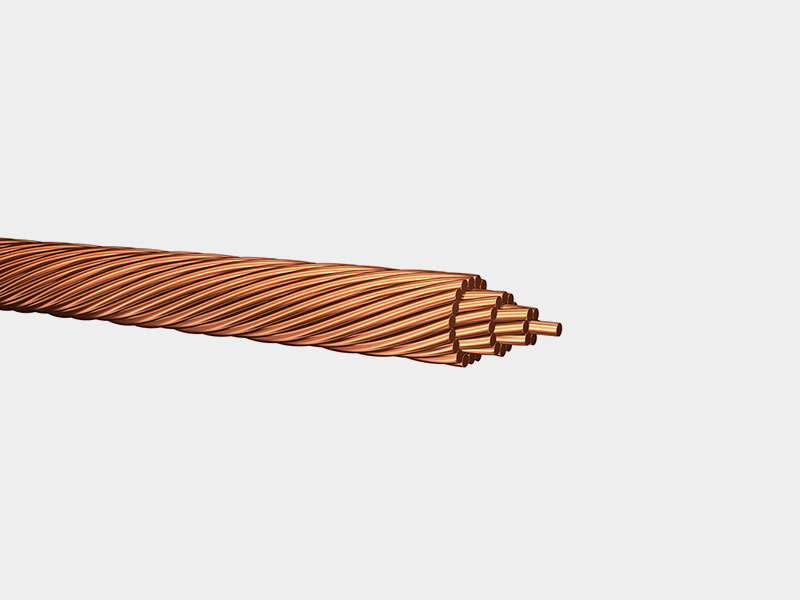
Bare copper conductors are essential in electrical infrastructure, known for their excellent conductivity and adaptability. This product page focuses on Class B Bare Copper Conductors, which are specifically designed to offer a balance of flexibility and robust performance in a variety of applications.
Overview of Class B Stranding
Class B bare copper conductors are characterized by their concentric-lay stranded construction, meaning they are composed of multiple layers of wires helically wrapped around a central core. This design imparts moderate flexibility, making them a versatile choice for applications where a certain degree of maneuverability is required without compromising strength or conductivity.
Key Characteristics of Class B Bare Copper Conductors
- Construction: Concentric-lay stranded, formed by multiple layers of wires wound together.
- Flexibility: Offers moderate flexibility, striking a balance between rigid conductors (like Class AA or A) and highly flexible conductors (like Class C or D). This characteristic makes them suitable for a wide range of installations.
- Materials: Typically manufactured from soft or annealed copper, as specified by ASTM B3, ensuring optimal electrical conductivity.
- Applications: Ideal for grounding systems, various types of building wire, and industrial cables, as well as other general-purpose electrical applications where moderate flexibility is beneficial.
- Standards: Primarily defined by ASTM B8 (Concentric-Lay-Stranded Copper Conductors).
- Comparison to other classes: Class B provides greater flexibility than Class AA and Class A conductors, but less flexibility than Class C and D conductors, fitting a specific niche for moderate flexibility requirements.
Construction
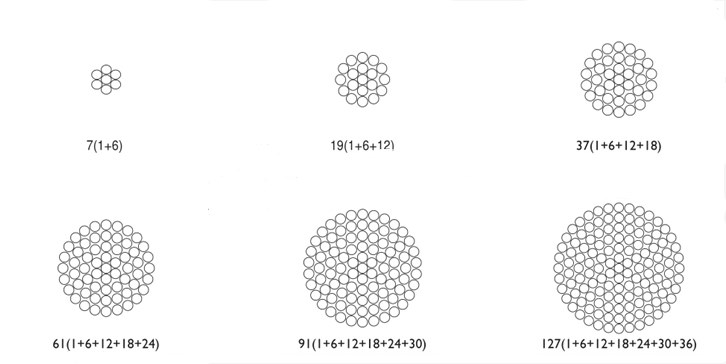
Solid or Concentric stranded bare Soft or Annealed Copper Construction
ASTM Standards
The quality and performance of bare copper conductors, including Class B stranding, are meticulously governed by ASTM (American Society for Testing and Materials) standards:
- ASTM B3: Standard Specification for Drawn and Annealed Copper Wire. This standard covers the requirements for drawn and annealed (soft) round bare copper wire, which is the foundational material for most stranded copper conductors, ensuring their purity and electrical properties.
- ASTM B8: Standard Specification for Concentric-Lay-Stranded Copper Conductors, Hard, Medium-Hard, or Soft. This crucial standard categorizes concentric-lay-stranded bare copper conductors into various classes (AA, A, B, C, and D) based on their flexibility and intended use. Class B conductors adhere to the specific stranding and lay requirements detailed in this standard to achieve their characteristic moderate flexibility.
Examples of Use
The moderate flexibility and reliable conductivity of Class B bare copper conductors make them suitable for numerous essential electrical applications:
- Grounding Systems: They are frequently employed in grounding networks for residential, commercial, and industrial facilities, ensuring electrical safety and effective fault current dissipation.
- Building Wire: Utilized in various electrical installations within buildings for power distribution and circuit wiring where a degree of flexibility is needed for routing and installation.
- Industrial Cables: Class B stranding is a common choice for internal wiring in machinery, control panels, and other industrial applications that require a durable yet moderately flexible conductor.
By meeting the rigorous specifications of ASTM B3 and B8, Class B bare copper conductors provide a dependable and adaptable solution for diverse electrical projects requiring a balance of strength, conductivity, and moderate flexibility.