
What is Telephone Cable?
The telephone cable is a copper cable that consists of several twisted wires. It is used to link telephone equipment to the public switched telephone network (PSTN) or private branch exchange (PBX), allowing people to make calls from one location to another. Telephone cable makes use of electrically conductive materials such as copper wiring to transmit data electromagnetically. The outer insulation is typically PVC (polyvinyl chloride) or polyethylene (PE). They are low-frequency devices, meaning that they operate below 300 kilohertz.
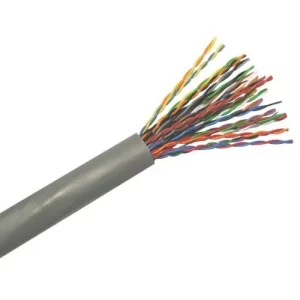
what is telephone cable
Telephone cables have evolved significantly since the early days of telephony, transforming from simple copper wire connections to sophisticated twisted-pair systems that can carry both voice and data communications.
Historical Evolution
The development of telephone cables parallels the evolution of telecommunications technology. Telegraphs used copper wires to transmit high currents of electricity but at low voltages, which would allow messages to be transmitted from one location to another. This foundation led to the development of telephone systems and the specialized cables needed to support them.
These wires were typically copper, although aluminium has also been used, and were carried in balanced pairs of open wire, separated by about 25 cm (10″) on poles above the ground, and later as twisted pair cables. Up to 600 conversations could be transmitted over two coaxial cables. Today most of the improvements in telephone cables have centered around sending more information at a faster rate over the same wires.
Types of Telephone Cables
Traditional Categories
Overall, phone cables have had a vast number of changes over the years, and phone cables are often identified by their use (the 'C' codes) instead of their type, but you can actually simplify most phone cables into just four basic groups: Lead, Paper, PIC and T-Screen.
Modern Cable Categories
Category 3 (Cat3) Cable
Short for Category 3, Cat3 Cable is an unshielded twisted pair (UTP) cable designed to reliably carry data up to 10 Mbit/s, with a possible bandwidth of 16 MHz. Cat3 has been the traditional standard for telephone installations and remains widely used for voice applications.
Cat3 Specifications:
- Bandwidth: 16 MHz
- Data rate: Up to 10 Mbps
- Conductor gauge: Typically 24 AWG
- Pair count: Usually 25 pairs for commercial installations
- Applications: Voice communications, basic data transmission
Higher Category Cables
Ethernet cables are also rated by category; the most common types are Cat5e, Cat6, and Cat6a. While primarily designed for data networks, these cables are increasingly used for modern telephone systems, especially VoIP (Voice over IP) applications.
Twisted Pair Configuration
The CAT 3 spec requires, among other things, that each pair be twisted. Don't expect CAT 3 to be twisted nearly as much as CAT 5 though and that's a good thing because it makes termination easier. The twisted pair design helps reduce electromagnetic interference and crosstalk between adjacent pairs.
Cable Construction and Components
Core Components
- Conductors: Typically solid copper wire, usually 24 AWG
- Insulation: Individual wire insulation, often color-coded
- Pair Twisting: Wires twisted together to reduce interference
- Cable Jacket: Outer protective covering (PVC or PE)
- Pair Identification: Color coding for easy identification
Multi-Pair Cables
Commercial telephone installations often use multi-pair cables containing 25, 50, 100, or more pairs of wires. The Cat3 Plenum Solid UTP Cable is an excellent choice when your application site is within plenums or airspaces. This phone cable features 25 unshielded solid copper pairs with a 24 AWG diameter cable.
Color Coding Standards
Telephone cables use standardized color codes for pair identification:
- Pair 1: White/Blue and Blue
- Pair 2: White/Orange and Orange
- Pair 3: White/Green and Green
- Pair 4: White/Brown and Brown
For multi-pair cables, additional color combinations and binder groups are used to identify larger numbers of pairs.
Connectors and Termination
RJ11 Connectors
The most common connector for telephone applications is the RJ11, though technically, most 'RJ11' connectors are actually 6P4C (6 position, 4 contact) connectors.
RJ11 Connector Features:
- 6 positions, typically 2 or 4 contacts used
- Standard for residential telephone connections
- Compatible with most telephone equipment
- Easy to terminate and replace
RJ12 and RJ25 Connectors
- RJ12: 6 position, 6 contact (6P6C) for multi-line phones
- RJ25: Used for three-line telephone systems
Professional Termination
Some installations pull a Cat.3 or Cat.5 cable in which has 4 pairs of wires and they are wrapped from top to bottom of the punch down, provide for 4 phone lines, multiple phone connections for each line all the way down the block.
Wiring Standards and Pinouts
USOC (Universal Service Ordering Code)
Traditional telephone wiring follows USOC standards:
- Line 1: Pins 3 and 4 (center pair)
- Line 2: Pins 2 and 5
- Line 3: Pins 1 and 6
International Variations
For example, telephone cables in the UK typically have a BS 6312 (UK standard) plug at the wall end and a 6P4C or 6P2C modular connector at the telephone end: this latter may be wired as per the RJ11 standard (with pins 3 and 4), or it may be wired with pins 2 and 5, as a straight-through cable from the BT plug.
Applications and Uses
Traditional Voice Communications
- Residential telephone service
- Business phone systems
- PBX (Private Branch Exchange) connections
- Extension wiring within buildings
- Intercom and paging systems
Modern Applications
- VoIP (Voice over IP) systems
- Internet connectivity for dial-up and DSL
- Alarm and security system communications
- Building automation and control systems
- Point-of-sale terminal connections
Data Transmission
While primarily designed for voice, telephone cables can carry data:
- Dial-up internet connections
- DSL broadband service
- Low-speed data communications
- Serial data transmission for industrial applications
Installation Considerations
Residential Installation
- Single-pair or two-pair cables for basic service
- Home run wiring from central distribution point
- Proper grounding and protection
- Code compliance for safety
Commercial Installation
- Multi-pair cables for multiple lines
- Structured wiring systems
- Cross-connect panels and punch-down blocks
- Professional-grade components and installation
Environmental Factors
- Indoor: Standard PVC jacket cables
- Outdoor: UV-resistant and moisture-proof cables
- Plenum: Fire-rated cables for air handling spaces
- Underground: Gel-filled or armored cables for burial
Differences from Data Cables
Frequency and Bandwidth
Telephone cables operate at much lower frequencies than data cables:
- Voice frequency range: 300 Hz to 3.4 kHz
- Data cables: Much higher frequency capabilities
- RJ11 and RJ45 are both cable connectors, but RJ11 is only capable of transmitting analog data, while RJ45 is better suited for digital ethernet traffic.
Physical Differences
- Connector size: RJ11 smaller than RJ45
- Number of contacts: RJ11 typically 4 contacts, RJ45 has 8
- Cable requirements: Less stringent specifications for telephone use
Testing and Troubleshooting
Common Testing Tools
- Tone generators: For cable tracing and identification
- Multimeters: For continuity and voltage testing
- Cable testers: For pair identification and fault location
- TDR (Time Domain Reflectometer): For cable length and fault distance
Common Problems
- Opens: Broken wires or poor connections
- Shorts: Wires touching causing cross-connection
- High resistance: Corrosion or poor connections
- Noise: Interference from electrical sources
- Crosstalk: Signal bleeding between pairs
Maintenance Best Practices
- Regular visual inspection of connections
- Testing of circuit continuity
- Monitoring for noise and interference
- Proper protection from moisture and corrosion
- Professional testing during installation
Modern Trends and Future
VoIP Integration
Modern telephone systems increasingly use VoIP technology, which can utilize standard data cabling infrastructure while maintaining compatibility with traditional telephone cables for legacy equipment.
Hybrid Systems
Many installations now combine traditional telephone cables with data cables to support both legacy phone systems and modern IP-based communications.
Fiber Integration
Long-distance telephone communications increasingly use fiber-optic cables, with copper telephone cables primarily used for the 'last mile' connections to end users.
Cost Considerations
Material Costs
- Cat3 telephone cable: Most economical for voice-only applications
- Higher category cables: More expensive but future-proof
- Multi-pair cables: Cost-effective for multiple line installations
Installation Costs
- Professional installation recommended for commercial applications
- Proper tools and testing equipment required
- Code compliance and inspection requirements
- Long-term reliability considerations
Safety and Code Compliance
Electrical Safety
- Proper grounding and bonding
- Protection from electrical hazards
- Lightning protection systems
- Isolation from power circuits
Building Codes
- Fire safety ratings for plenum installations
- Proper cable support and routing
- Access and serviceability requirements
- Integration with building infrastructure
Conclusion
Telephone cables remain a fundamental component of communications infrastructure, bridging the gap between traditional voice communications and modern digital systems. Understanding the different types, specifications, and applications of telephone cables is essential for anyone involved in telecommunications installation, maintenance, or planning.
While newer technologies like fiber optics and wireless communications continue to evolve, telephone cables continue to play a crucial role in providing reliable, cost-effective voice and data communications. Whether installing a simple residential phone line or designing a complex commercial communications system, proper selection and installation of telephone cables ensures reliable service and future expandability.
The evolution from simple copper wire to sophisticated twisted-pair systems demonstrates the adaptability of telephone cable technology. As communications needs continue to evolve, telephone cables will likely continue to adapt, supporting both legacy systems and emerging technologies in the ever-changing landscape of telecommunications.


