
You're about to buy cables for a new machine. The salesperson pushes 'high-flex' cables at 5x the price of standard cables. Are they worth it, or just an upsell?
Or worse: You installed standard cables to save money. Three months later, they've failed, and your production line is down. The replacement cost—including downtime, labor, and rush shipping—is now 10x what you 'saved.'
High-flex cables aren't always necessary. But when they are, they're irreplaceable. This guide tells you exactly when to upgrade and when to save your money.
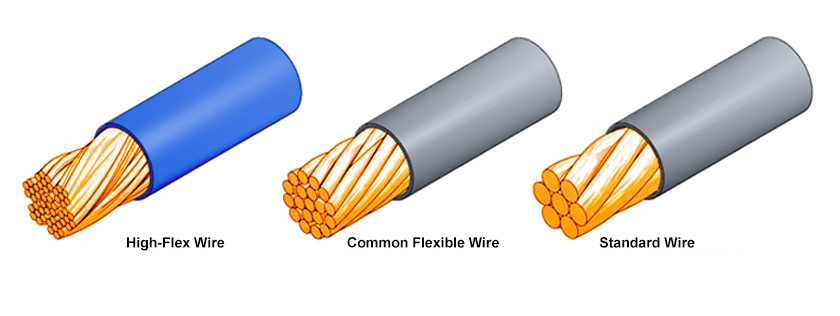
High-Flex Cable vs Standard Cable
What Makes High-Flex Cables Different
Before deciding if you need high-flex, understand what you're actually paying for.
Standard Cable Construction
Typical features:
- Conductor: 7-19 strands (Class B stranding)
- Insulation: Standard PVC or rubber
- Jacket: Regular PVC or basic rubber
- Design: Cost-optimized for fixed installations
- Flex life: 100-1,000 bend cycles
- Cost: $ (baseline)
Good for:
- Fixed installations
- Permanent wiring
- Occasional movement (moving equipment once in a while)
Fails when:
- Bent repeatedly in same location
- Used in continuous motion applications
- Subjected to vibration or flexing
High-Flex Cable Construction
Specialized features:
- Conductor: 100-1,000+ ultra-fine strands (Class 5/6)
- Special lay: Conductors arranged in precise patterns
- Insulation: Flexible compounds (TPE, special PVC)
- Fillers: Talc or special materials reduce friction
- Jacket: High-performance PUR, TPE, or neoprene
- Design: Engineered for millions of flex cycles
- Flex life: 100,000 to 5+ million cycles
- Cost: $$$-$$$$$ (3-10x standard)
Good for:
- Drag chains and cable carriers
- Robotic applications
- Continuous motion machinery
- High-cycle flexing
Worth it when:
- Downtime cost exceeds cable cost
- Replacement is difficult or expensive
- Application genuinely requires flex cycles
The Flex Life Reality: Numbers That Matter
Understanding flex cycles is key to making the right decision.
What Is a Flex Cycle?
One flex cycle = one complete bend and return to straight
Example: Drag chain moving back and forth
- Start position → Extended → Return to start = 1 cycle
Typical Flex Life by Cable Type
| Cable Type | Flex Cycles | Example Cost/m | Cost per Million Cycles |
|---|---|---|---|
| Standard building wire | 100-500 | $0.50 | $1,000-5,000 |
| Flexible cord (Class C) | 1K-5K | $1.50 | $300-1,500 |
| High-flex rated | 100K-500K | $8 | $16-80 |
| Ultra high-flex | 1M-5M | $25 | $5-25 |
| Premium robot cable | 5M-10M | $50 | $5-10 |
The surprising truth: Premium cables are cheaper per flex cycle than standard cables.
Calculate Your Actual Flex Cycles
Formula:
Total Cycles = Cycles per minute × Minutes per hour × Hours per day × Days per year × Years

Example - CNC machine drag chain:
- 30 cycles/min (machine movement)
- 60 min/hour × 16 hours/day (2 shifts)
- 250 days/year
- 5 year lifespan target

Total = 30 × 60 × 16 × 250 × 5 = 36,000,000 cycles
This application needs ultra high-flex cable (5M+ rating)
Standard cable would fail in:
500 cycles ÷ 30 cycles/min = 16 minutes
When Standard Cable Is Perfectly Fine
Don't waste money on high-flex when standard works.
Fixed Installations
Characteristics:
- Cable installed once, never moves
- Run in conduit, cable tray, or on walls
- No vibration or movement expected
- Easy access for future replacement
Examples:
- Building power distribution
- Lighting circuits
- Fixed equipment connections
- Control panel wiring
Use standard cable:
- Building wire (THHN, H07V-U)
- Standard control cable
- Basic instrumentation cable
Cost savings: 80-95%
Real example:
- Machine control panel to fixed sensor, 20 meters
- Standard cable: $1.50/m × 20m = $30
- High-flex cable: $12/m × 20m = $240
- Savings: $210 (money wasted on unnecessary feature)
Occasional Movement
Characteristics:
- Equipment moved for maintenance (monthly or less)
- Portable tools used occasionally
- Cable flexing happens but infrequently
- Lifetime flex cycles: <10,000
Examples:
- Portable power tools used occasionally
- Equipment serviced monthly
- Test equipment moved between stations
- Movable machinery (adjusted then fixed)
Use flexible cable (not high-flex):
- SOOW portable cord
- H07RN-F flexible cable
- Standard flexible control cable
Cost savings: 60-80%
Real example:
- Portable grinder, 10 meter cord, used 2 hours/week
- Flexible cord: $3/m × 10m = $30
- High-flex cable: $15/m × 10m = $150
- Expected cycles over 5 years: ~5,000
- Flexible cord adequate, saves $120
Low-Cycle Flex Applications
Characteristics:
- Regular flexing but low frequency
- Lifetime cycles: 10,000-50,000
- Not continuous motion
- 1-2 year replacement acceptable
Examples:
- Door/gate connections (opens/closes daily)
- Equipment dress cables (flexes when machine operates)
- Occasional automated movement
Use enhanced flexible cable:
- Premium flexible cord
- Flex-rated control cable (not ultra-flex)
Cost savings: 40-60%
When You MUST Upgrade to High-Flex
These applications destroy standard cables in days or weeks.
Drag Chains and Cable Carriers
Why high-flex is mandatory:
- Continuous back-and-forth motion
- Thousands of cycles per day
- Constrained bend radius
- Multiple cables rubbing together
Typical cycle counts:
- CNC machine: 5,000-15,000 cycles/day
- Pick-and-place: 20,000-50,000 cycles/day
- Gantry system: 10,000-30,000 cycles/day
Over 5 years: 9-45 million cycles
Required cable specs:
- Class 5 or 6 stranding (fine conductors)
- Flex-rated insulation (TPE or PUR)
- Talc or special filler (reduces friction)
- PUR jacket (abrasion resistant)
- Rated for 1M+ cycles minimum
Cost comparison:
Standard cable: $2/m, fails in 1 month
→ 60 replacements over 5 years
→ Cost: 60 × ($2 + $50 labor + $500 downtime) = $33,120

High-flex cable: $15/m, lasts 5 years
→ 1 installation
→ Cost: $15 + $50 labor = $65

Savings: $33,055 (509x return on investment)
Don't even consider standard cable for this application.
Industrial Robots
Why high-flex is mandatory:
- Multi-axis movement (complex motion)
- Torsion at joints (twisting stress)
- Millions of cycles over robot lifetime
- Replacement extremely costly
Typical requirements:
- 6-axis robot: 2-5 million cycles
- SCARA robot: 3-8 million cycles
- Delta robot: 5-10 million cycles
Required cable specs:
- Ultra-fine stranding (rope-lay construction)
- Torsion-resistant design
- Served shield (spiral, not braid)
- Premium PUR jacket
- Rated for 5M+ cycles
- Often 10-20x cost of standard
Real example:
- Automotive welding robot, 4m cable
- Standard cable: Fails in 2 weeks, $200 replacement + $5,000 downtime per failure
- Robot cable: $80/m × 4m = $320, lasts robot lifetime (5+ years)
- Standard cable over 5 years: ~130 failures × $5,200 = $676,000
- High-flex saves: $675,680
For robots: Always use manufacturer-specified or premium robot cable.
Continuous Flexing Applications
Characteristics:
- Non-stop movement during operation
- High frequency (>100 cycles/hour)
- Expected lifetime: 500,000+ cycles
Examples:
- Automated packaging lines
- Conveyor systems with moving components
- Textile machinery
- Printing equipment
- Automated warehouse systems
Required cable:
- Minimum 500K cycle rating
- Proper bend radius maintained
- Installation follows manufacturer guidelines
Rule of thumb:
If cycles/day × days/year × years > 100,000
→ High-flex cable required
High-Vibration Environments
Why high-flex helps:
- Vibration = repeated micro-flexing
- Standard cable conductors fatigue and break
- Failures often intermittent (hard to diagnose)
Examples:
- Cables on vibrating machinery
- Connections to motors or compressors
- Marine applications (engine room)
- Heavy equipment
Solution:
- High-flex cable or vibration-rated cable
- Proper strain relief critical
- Allow slack for vibration absorption
The Gray Area: When It's Not Obvious
Some applications fall between 'definitely standard' and 'must be high-flex.'
Cable Dress to Moving Equipment
Scenario: Cable from fixed point to machine that moves occasionally
Factors to consider:
Use standard if:
- Machine moves <10 times per day
- Movement is slow and gentle
- Cable has generous slack (loose loop)
- Replacement is easy and cheap
Upgrade to high-flex if:
- Machine moves 50+ times per day
- Movement is rapid or jerky
- Limited space (tight bending)
- Replacement requires production shutdown
Real example - Injection molding machine:
- Mold opens/closes: 200 cycles/day
- 250 days/year = 50,000 cycles/year
- 5 years = 250,000 total cycles
- Standard cable: Fails after ~1,000 cycles (5 days)
- Verdict: High-flex required
Robotic Arms with Low Duty Cycle
Scenario: Robot operates intermittently, not continuously
Factors:
Standard flex-rated may work if:
- Robot runs <4 hours/day
- Slow movements, gentle on cables
- Not welding/high-EMI environment
- Budget very constrained
Upgrade to robot-rated if:
- Any welding application (spatter damage)
- High speeds or accelerations
- Expected lifespan >3 years
- Downtime cost >$1,000/hour
Conservative approach: Use robot cable anyway. The cost difference ($500-1,000) is insignificant compared to one failure.
Festoon Systems
Scenario: Cables hang in loops, travel horizontally
Characteristics:
- Less severe than drag chains (no constrained bending)
- But still continuous motion
- Weight and sag create stress
Cable selection:
- Short spans (<5m): High-flex rated adequate
- Long spans (>5m): Premium high-flex or festoon-specific
- Heavy cables: Reinforced or with messenger wire
Typical lifespan targets:
- 500K-2M cycles depending on speed and weight
Cost-Benefit Analysis Framework
Use this decision matrix:
Step 1: Calculate Replacement Cost
Total replacement cost includes:
- New cable cost
- Labor to remove and install
- Downtime cost (production loss)
- Emergency service premium (if unplanned)
Example:
Cable: $100
Labor: $200 (4 hours @ $50/hr)
Downtime: $5,000 (5 hours @ $1,000/hr)
Emergency: $500 (rush shipping)
Total replacement cost: $5,800
Step 2: Estimate Lifetime Cycles
Use the formula from earlier:
Cycles per min × 60 × hours per day × days per year × years
Step 3: Calculate Expected Failures
Standard cable:
Total lifetime cycles ÷ Cable flex rating = Number of failures

Example: 1,000,000 cycles ÷ 500 cycle rating = 2,000 failures
High-flex cable:
1,000,000 cycles ÷ 2,000,000 cycle rating = 0.5 failures (probably 1)
Step 4: Compare Total Cost
Standard cable total cost:
(Initial cost + installation) + (Failures × Replacement cost)

Example:
($50 + $50) + (2,000 × $5,800) = $11,600,100
High-flex cable total cost:
(Initial cost + installation) + (Failures × Replacement cost)

Example:
($400 + $50) + (1 × $5,800) = $6,250
Savings: $11,593,850
(Extreme example to illustrate the point—adjust for your actual numbers)
Decision Rule
Use high-flex if:
(High-flex cost) < (Standard cost + (Expected failures × Replacement cost))
Usually, if you expect more than 1-2 failures over the equipment lifetime, high-flex pays for itself.
Installation Matters: Make Your Cable Last
Even the best high-flex cable fails if installed wrong.
Critical Installation Factors
Bend Radius:
- Manufacturer specifies minimum (typically 10x diameter)
- Never exceed this in actual installation
- Measure actual radius, don't guess
- Multiple bends are cumulative (stress adds up)
Cable Carrier Sizing:
- Fill ratio: 50-70% maximum (cables need room to move)
- Inner radius matches cable minimum bend radius
- Width prevents cable stacking/piling
- Dividers separate power and signal cables
Support and Strain Relief:
- Both ends must be properly secured
- No tension on cable during motion
- Allow slight slack (not too tight)
- Use proper cable glands
Speed and Acceleration:
- High-flex cables have speed ratings
- Rapid acceleration worse than high steady speed
- Exceed ratings = shortened life
Environment:
- Keep cables clean (chips, coolant, etc. cause wear)
- Verify temperature within rating
- Check for chemical exposure
- Protect from UV if applicable
Common Installation Mistakes
Mistake 1: Too tight bend radius
- Cable looks fine but fails quickly
- Conductors break at bend point
- Solution: Use larger radius carrier or fewer cables
Mistake 2: Overfilled carrier
- Cables can't move freely
- Increased friction and wear
- Solution: Larger carrier or multiple carriers
Mistake 3: Mixed cable types
- Standard and high-flex together in carrier
- Standard cables fail and damage others
- Solution: All cables in carrier should be same flex rating
Mistake 4: No strain relief
- Cable pulls at connectors
- Premature connector failure
- Solution: Proper cable glands and securing
Quick Decision Guide
Fixed Installation
- Never moves → Standard building wire
- Moved for maintenance (monthly) → Standard cable
- Cost factor: 1x
Occasional Flex
- Portable tools (used occasionally) → Flexible cord
- Equipment adjustment (weekly) → Flexible cable
- Lifetime cycles: <10,000
- Cost factor: 2-3x
Frequent Flex
- Daily movement → Enhanced flexible cable
- Equipment dress (50-200 cycles/day) → Flex-rated cable
- Lifetime cycles: 10,000-100,000
- Cost factor: 3-5x
Continuous Motion
- Drag chains → High-flex rated cable
- Cable carriers → High-flex rated (1M+ cycles)
- Lifetime cycles: 100,000-2M
- Cost factor: 5-8x
Extreme Flex
- Industrial robots → Ultra high-flex or robot cable
- High-speed automation → Premium high-flex
- Lifetime cycles: 2M-10M
- Cost factor: 10-20x
The Bottom Line
High-flex cables are not always worth it—but when they are, they're irreplaceable.
Use standard cable when:
- ✅ Fixed installation, never moves
- ✅ Occasional movement (<100 cycles/year)
- ✅ Easy and cheap to replace
- ✅ Downtime cost is minimal
- Savings: 80-95%
Upgrade to high-flex when:
- ✅ Continuous motion (drag chains, robots)
- ✅ Lifetime cycles >100,000
- ✅ Replacement is costly or difficult
- ✅ Downtime cost >$500/hour
- ROI: Often 100-1000x
The calculation is simple:
If (cost of one failure) > (high-flex upgrade cost)
→ Buy high-flex

If (expected failures × replacement cost) > (high-flex price)
→ Buy high-flex

Otherwise → Standard cable is fine
Three golden rules:
- Calculate actual flex cycles - Don't guess, do the math
- Consider total cost - Not just cable price, but replacement + downtime
- Install properly - Even the best cable fails if installed wrong
Most common mistake: Using standard cable in continuous flex applications to 'save money.' The first failure costs more than 10x the price difference.
Second most common mistake: Using premium high-flex in fixed installations where standard works fine. This wastes 80% of your budget.
Match the cable to the application, and it will last its designed lifetime.
Now you know when to upgrade and when to save your money. Make the decision based on your actual requirements, not on sales pitches or false economy.


