
When planning a cabling installation, one of the most common and critical questions is:
'Should I use plenum cable or riser cable?'
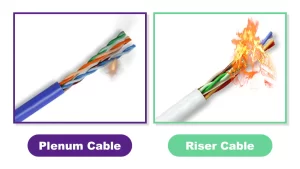
Plenum Cable vs. Riser Cable
Choosing the wrong type can lead to failed inspections, fire code violations, or worse—serious safety risks. This guide will walk you through the key differences between plenum-rated (CMP) and riser-rated (CMR) cables, and help you determine which one is required for your project.
📌 Quick Answer
-
Use Plenum Cable (CMP) for air-handling spaces like drop ceilings or HVAC returns.
-
Use Riser Cable (CMR) for vertical runs between floors (non-airflow spaces).
🔍 What Is Plenum Cable?
Plenum cable, rated CMP, is designed for use in air circulation spaces—areas that can spread smoke and fire rapidly if not properly protected.
Key Features:
-
Fire Rating: Highest level (passes UL 910 flame test)
-
Smoke/Toxicity: Emits low smoke and low toxic gases
-
Jacket Material: Often FEP or LSZH (low smoke zero halogen)
-
Required In: Drop ceilings, HVAC ducts, raised floors used for air circulation
✅ Example Applications:
-
Office buildings with return-air ceiling systems
-
Hospitals
-
Schools and universities
-
Data centers with plenum-rated environments
🔧 What Is Riser Cable?
Riser cable, rated CMR, is made for vertical shafts or spaces between building floors that are not part of the HVAC air-handling system.
Key Features:
-
Fire Rating: Moderate (passes UL 1666 flame test)
-
Smoke/Toxicity: Emits more smoke than plenum but still controlled
-
Jacket Material: Usually PVC
-
Required In: Non-plenum vertical runs (e.g., wiring closets on different floors)
✅ Example Applications:
-
Running cable between floors through walls or conduits
-
Apartments or commercial riser shafts
-
Any non-airflow, vertical application
🧯 Fire Ratings Compared
| Feature | Plenum Cable (CMP) | Riser Cable (CMR) |
|---|---|---|
| Fire Test Standard | UL 910 | UL 1666 |
| Flame Resistance | Excellent | Good |
| Smoke Emission | Very Low | Moderate |
| Use in Airspaces | Yes | No |
| Toxic Fumes | Minimal | Higher than plenum |
| Typical Jacket Material | FEP, LSZH | PVC |
💵 Cost Comparison
Plenum cable generally costs more than riser cable due to stricter material and testing requirements.
| Cable Type | Approx. Cost per 1000 ft |
|---|---|
| Cat6 CMP | $$$ (higher) |
| Cat6 CMR | $$ (moderate) |
💡 Tip: Only use plenum cable where required by code—no need to overspend if you're not installing in an air-handling space.
🛠 When to Use Plenum vs. Riser Cable?
Here’s a simple guide:
| Installation Location | Recommended Cable Type |
|---|---|
| Drop ceilings (return air) | Plenum (CMP) |
| HVAC ductwork | Plenum (CMP) |
| Raised floors (airflow) | Plenum (CMP) |
| Between floors (in walls) | Riser (CMR) |
| Riser shafts (no airflow) | Riser (CMR) |
| Residential wall wiring | CM or CMR |
| Outdoor/direct burial | Use outdoor-rated cable (not CMP/CMR) |
🏗 Can You Use Plenum Cable Instead of Riser?
Yes, plenum cable can always be used in place of riser cable, because it meets stricter standards. But using riser cable in a plenum space is a code violation and a serious fire hazard.
🧠 Best Practice: If in doubt, default to plenum-rated cable—but confirm your local building code to avoid unnecessary cost.
✅ Final Recommendations
-
For commercial spaces with return-air systems: Go with CMP plenum cable.
-
For vertical runs between floors in non-airflow areas: Choose CMR riser cable.
-
For general use in walls or open space: Riser cable is often sufficient.
-
Never use riser cable in a plenum space.


