
If you're working with American Wire Gauge (AWG) standards and need to convert 20 AWG to mm², you're in the right place. This article explains the conversion, typical applications of 20 AWG wire, and what to consider when choosing between AWG and metric wire sizes.
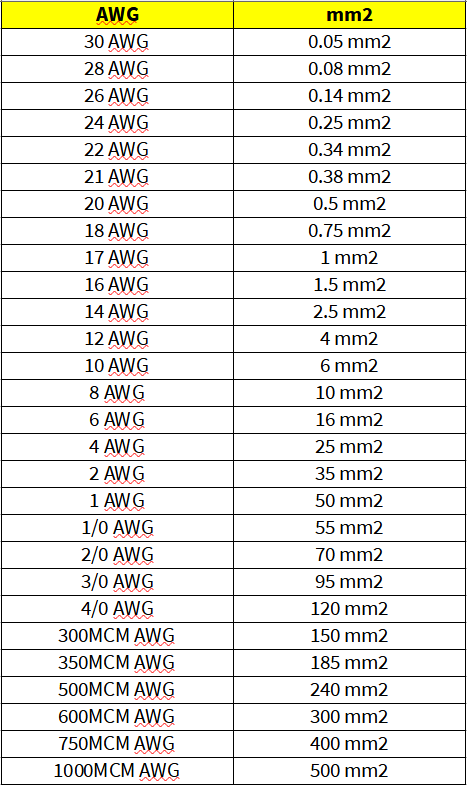
awg 20 to mm2
📏 AWG 20 to mm² Conversion
20 AWG = approximately 0.52 mm²
This means a 20 AWG wire has a cross-sectional area of about 0.52 square millimeters, making it comparable to 0.5 mm² wires commonly used in metric-based systems.
| AWG Size | Cross-Section (mm²) | Diameter (mm) | Typical Amp Rating |
|---|---|---|---|
| 20 AWG | 0.52 mm² (approx.) | ~0.81 mm | 5–7 amps (depending on insulation and environment) |
✅ Note: This is a rounded value and may vary slightly depending on solid or stranded conductors.
🔧 Applications of 20 AWG / 0.5 mm² Wire
20 AWG wire is often used in low-voltage, low-current applications, including:
-
Signal transmission
-
LED lighting circuits
-
Alarm and security systems
-
Automotive and marine control wires
-
Electronics and PCB wiring
-
Thermostats and smart home systems
Its compact size and flexibility make it ideal for tight installations and control systems where space is limited.
🧰 Solid vs Stranded 20 AWG Wire
-
Solid wire offers better rigidity and is ideal for permanent installations.
-
Stranded wire is more flexible, better for applications with movement or vibration.
Whether you need UL-listed 20 AWG control wire or 0.5 mm² THW/THHN insulated copper wire, understanding this size helps ensure electrical safety and compliance.
🔄 AWG to mm² Quick Reference (Selected Sizes)
| AWG | mm² (approx.) |
|---|---|
| 24 AWG | 0.20 mm² |
| 22 AWG | 0.33 mm² |
| 20 AWG | 0.52 mm² |
| 18 AWG | 0.82 mm² |
| 16 AWG | 1.31 mm² |
| 14 AWG | 2.08 mm² |
🌐 Choosing Between AWG and Metric Sizes
If you're sourcing cables internationally or working with both UL/NEC and IEC standards, it's important to know that:
-
0.5 mm² is the closest equivalent to 20 AWG, but they are not identical.
-
Always refer to ampacity charts and insulation ratings when making a final selection.
-
Mismatch in wire sizing can lead to voltage drop, overheating, or code violations.


