
As electronic devices become faster, smaller, and more power-efficient, the demand for high-speed, low-noise signal transmission has grown—especially in applications like displays, cameras, and embedded systems. This is where LVDS cables come in.
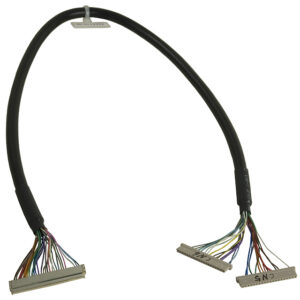
what is lvds cable
But what exactly is an LVDS cable, and why is it commonly used in modern electronics?
🔍 Definition: What Is LVDS Cable?
LVDS stands for Low Voltage Differential Signaling. An LVDS cable is a specialized cable designed to carry high-speed digital signals using differential signaling with very low voltage levels (typically 350mV).
Rather than transmitting a signal relative to ground (like traditional single-ended signaling), LVDS transmits pairs of opposite signals (positive and negative) across a twisted pair of wires. This approach minimizes noise and allows high data transfer rates.
⚙️ How LVDS Works
LVDS uses differential pairs—two conductors carrying equal and opposite signals. A receiver detects the voltage difference between the two lines, rather than their absolute voltage to ground.
Key characteristics:
-
Signaling voltage: ~350 mV
-
Common data rates: up to 655 Mbps or higher
-
Noise immunity: Very high, due to differential structure
-
Power consumption: Low
🧱 LVDS Cable Construction
An LVDS cable typically includes:
-
Multiple twisted pairs for differential signals
-
Shielding to prevent EMI (electromagnetic interference)
-
Insulation with low-capacitance material
-
Outer jacket for physical protection (PVC or LSZH, depending on use)
Some LVDS cables also include drain wires or foil shields for improved grounding and noise suppression.
🛠 Common Applications of LVDS Cables
LVDS cables are widely used in electronics where reliable, high-speed data transmission is required. Typical applications include:
-
LCD Displays: Connecting the controller board to the screen
-
CCTV and Industrial Cameras
-
Medical Devices
-
Automotive Displays and Systems
-
Embedded Systems and Development Boards
-
Consumer Electronics (laptops, tablets, gaming devices)
-
FPGA and Microcontroller Interfaces
✅ Advantages of LVDS Cables
-
🔹 High Data Rates over long distances (especially inside devices)
-
🔹 Excellent Noise Immunity, ideal for EMI-sensitive environments
-
🔹 Low Power Consumption compared to TTL or CMOS
-
🔹 Compact and Lightweight, perfect for slim devices
-
🔹 Less Crosstalk, especially when using shielded twisted pairs
⚖️ LVDS vs HDMI vs VGA
| Feature | LVDS | HDMI | VGA |
|---|---|---|---|
| Signal Type | Digital (differential) | Digital | Analog |
| Data Rate | High | Very High | Low |
| Cable Length | Medium | Short | Long (with signal degradation) |
| Typical Use | Internal display wiring | TVs, monitors | Older projectors, monitors |
| EMI Resistance | High | Moderate | Low |
💡 Note: LVDS is mainly used for internal display connections (like laptop screens), while HDMI is for external video/audio transmission.
📦 Summary
An LVDS cable is a vital component in modern electronics, enabling fast, low-power, and noise-resistant digital communication. Its unique differential signaling makes it ideal for environments where signal integrity is essential.
📞 Need Custom LVDS Cables?
TOT Wire & Cable supplies high-performance LVDS cables for industrial and commercial applications. Custom shielding, lengths, and connector options available.
👉 Contact us to get a quote or request a datasheet.


